The History of Fashion
Every piece of clothing has lived a life before it reached your wardrobe. Follow the thread back through history and discover where the story begins.

Fashion is far older than glamorous runways, luxury brands, or designer labels. Long before clothing became a statement of taste, wealth, or identity, it answered far more immediate needs. It shielded people from freezing winds, scorching deserts, rough terrain, and harsh climates. Over thousands of years, those simple coverings evolved into symbols of culture, artistry, status, and individuality.
The afternoon sun filters gently through the broad branches of a fig tree. A quiet river winds its way through a landscape untouched by cities, roads, or monuments. There are no looms, sewing needles, or spinning wheels—only two people standing in silence, carefully fastening large green leaves together with slender vines.
It is a simple act, yet it carries extraordinary significance.
Whether viewed as sacred history or symbolic storytelling, the image of Adam and Eve covering themselves with fig leaves has remained one of humanity’s most enduring visual narratives. According to the Book of Genesis, they became aware of their nakedness after eating from the Tree of the Knowledge of Good and Evil. In response, they fashioned coverings from fig leaves. Their creation was neither luxurious nor decorative. It was practical, deeply personal, and born from a new awareness of themselves.
At first glance, this scene may appear to be about modesty alone. Look a little closer, however, and another question begins to emerge: Could this moment also represent humanity’s first conscious act of dressing?
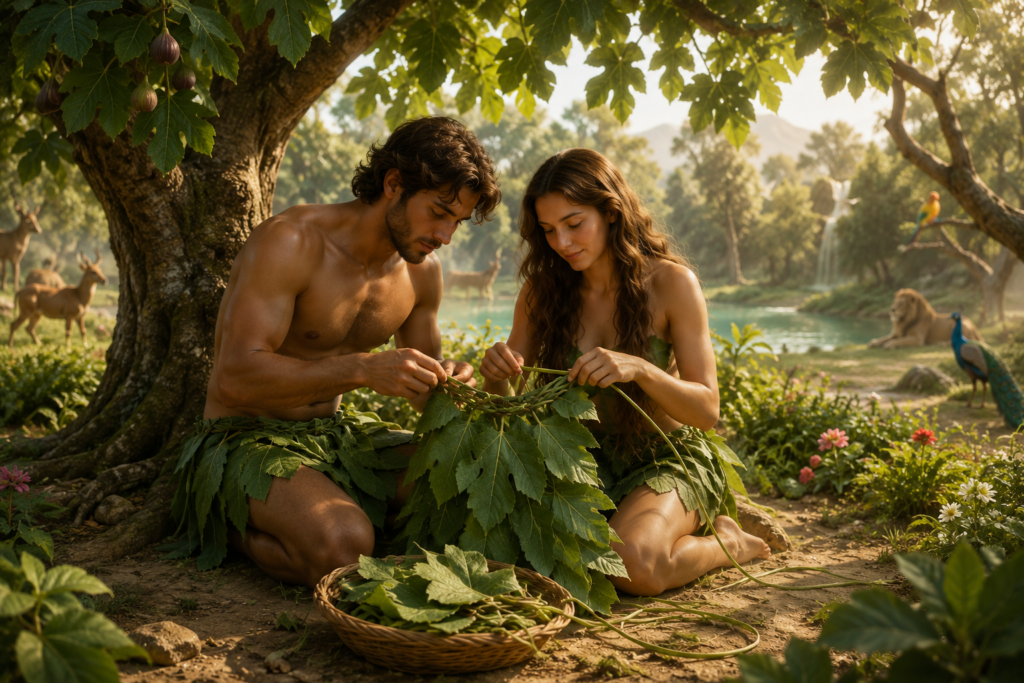
That question has fascinated theologians, historians, anthropologists, and fashion scholars for generations. While archaeological evidence points to early humans wearing animal hides and plant fibers tens of thousands of years before written history, the biblical account remains one of the earliest recorded narratives describing people intentionally making coverings for their bodies. The two perspectives come from different forms of evidence—one rooted in faith and ancient scripture, the other in archaeology and material discoveries—and together they invite a broader conversation about how humans began to dress.
Today, fashion shapes industries worth billions of dollars, influences politics and popular culture, preserves cultural traditions, and allows individuals to express who they are without speaking a single word. Yet every carefully tailored suit, handwoven textile, embroidered robe, and contemporary streetwear trend traces its roots back to one fundamental human instinct: the desire to protect, adapt, and eventually express ourselves.
This journey spans prehistoric caves, fertile river valleys, ancient kingdoms, medieval workshops, royal courts, industrial factories, and modern fashion capitals. Along the way, clothing transformed from a tool for survival into one of humanity’s most recognizable forms of communication.
Understanding that journey means looking beyond fabrics and garments. It means exploring the people who created them, the societies that gave them meaning, and the countless innovations that shaped what we wear today.
What Is Fashion?
People often use the words fashion and clothing interchangeably, but they are not quite the same. Clothing refers to garments created primarily to cover or protect the body. A heavy animal hide worn during an Ice Age winter, for example, served an essential purpose: survival. It offered warmth against freezing temperatures and protection from the environment. Function came first.
Fashion, on the other hand, goes beyond necessity.
Fashion begins when people choose how they want to present themselves rather than simply what they need to wear. It reflects preferences, cultural values, creativity, identity, and sometimes even rebellion. Two garments may provide the same protection from the weather, yet differ dramatically in color, decoration, craftsmanship, or symbolism. Those differences mark the transition from clothing to fashion.
This distinction did not happen overnight. It developed gradually over thousands of years as communities became more settled, technologies improved, and societies grew increasingly complex.
In many cultures, clothing soon began communicating messages long before spoken introductions.
A person’s garments could reveal:
- social status
- occupation
- age
- marital status
- religious beliefs
- regional identity
- wealth
- political influence
Even today, clothing continues to send these silent signals. A judge’s robe conveys authority. A military uniform reflects service and rank. Traditional ceremonial dress connects individuals to generations of cultural heritage. A wedding gown, graduation robe, or business suit each carries meanings understood within their respective societies. Fashion therefore became more than fabric stitched together. It evolved into a visual language.
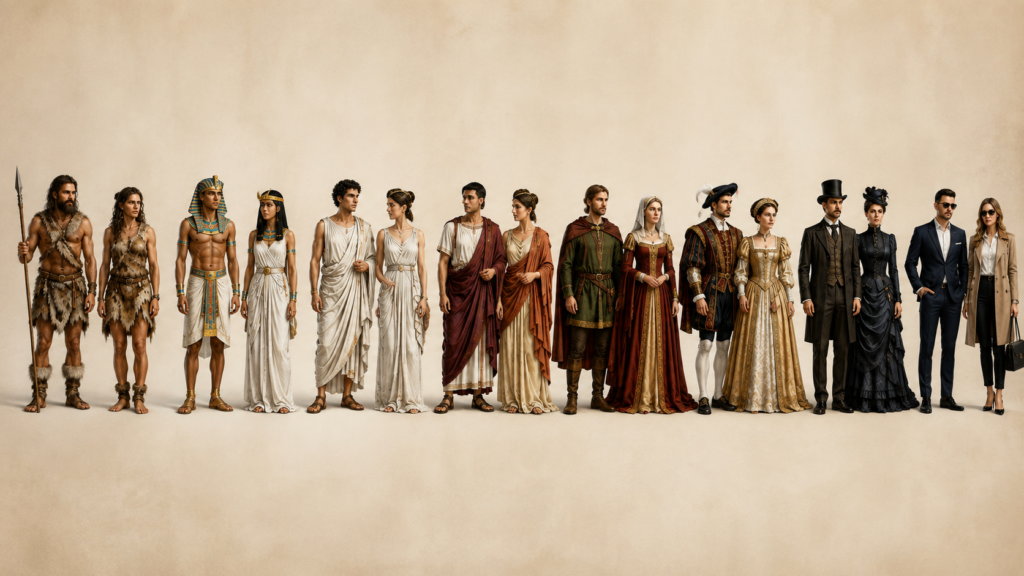
Throughout history, this language has constantly changed. Trade routes introduced new textiles and dyes. Religious customs influenced modesty and ornamentation. Technological advances transformed production methods. Political revolutions reshaped styles, while artistic movements inspired entirely new aesthetics.
Fashion also reveals something deeply human: the desire not only to survive but to belong, to stand out, to celebrate, to mourn, to honor tradition, and sometimes to challenge it.
That is why historians often study clothing alongside architecture, literature, art, and archaeology. Garments preserve stories that written records sometimes overlook. A fragment of woven cloth, a decorative bead, or a dyed textile can reveal surprising details about trade, craftsmanship, climate, and cultural exchange.
Understanding fashion, therefore, means understanding people.
The Earliest Evidence of Human Covering
Long before written history began, our ancestors faced a simple challenge: surviving in environments that were often unforgiving.
The earliest humans did not wake up wondering what looked fashionable. Their concerns were far more immediate. Cold winds, intense sunlight, rain, insects, and rough landscapes demanded practical solutions. Covering the body became one such solution.
Because materials such as leaves, grasses, bark, and untreated animal skins decompose over time, direct evidence of the earliest clothing is extremely rare. Archaeologists therefore rely on indirect clues to reconstruct this chapter of human history.
Among the most important discoveries are specialized stone tools used for scraping animal hides. These tools suggest that prehistoric communities processed skins into softer, more usable coverings. Bone needles, some dating back tens of thousands of years, indicate that people eventually learned to stitch pieces of hide together rather than simply draping them over their bodies.
[Image Suggestion: Prehistoric humans wearing animal skins while making clothing with bone needles.]
Scientific studies have also examined the evolutionary history of clothing lice, parasites that thrive only on dressed humans. By estimating when these lice diverged from head lice, researchers have proposed that regular clothing use likely began tens of thousands of years ago, although the exact timeline remains debated.
This evidence tells us something important.
Clothing almost certainly existed long before written language. The materials themselves may have disappeared, but the tools left behind reveal remarkable ingenuity. Early humans scraped hides, twisted plant fibers into cord, pierced leather with sharpened bone, and adapted their clothing to different climates. Communities living in colder regions likely relied heavily on fur-lined garments, while those in warmer environments may have used bark cloth, woven grasses, or large leaves.
Necessity encouraged innovation.
Over time, practical knowledge became a shared tradition. Parents taught children how to prepare hides, weave fibers, or fasten garments. These skills became part of everyday life, laying the foundation for textile craftsmanship that would eventually flourish in ancient civilizations.
As settlements expanded and food supplies became more stable, people found greater opportunities to decorate what they wore. Shells, feathers, beads, pigments, and carved ornaments began appearing alongside functional clothing. These additions served no obvious survival purpose. Instead, they hinted at something new: symbolism.
A necklace might identify a clan.
A feather arrangement might signify achievement.
Colored pigments could indicate participation in ceremonies or rituals.
Here, the earliest seeds of fashion begin to emerge.
The transition was gradual, but it marked a profound shift in human behavior. Clothing no longer protected only the body—it also began expressing meaning.
Did the Story of Adam and Eve Mark the Earliest Recorded Origin of Fashion?
Among the many stories that seek to explain humanity’s beginnings, few have had a greater cultural influence than the account of Adam and Eve in the Book of Genesis.
According to the biblical narrative, after eating from the Tree of the Knowledge of Good and Evil, Adam and Eve became aware of their nakedness. Their immediate response was not to build a shelter or seek food. Instead, they sewed fig leaves together to make coverings for themselves.
That brief passage has inspired artists, theologians, philosophers, and historians for centuries.
For many believers, it represents humanity’s first conscious act of making and wearing body coverings. Unlike naturally occurring animal fur or leaves used for temporary protection, the Genesis account describes intentional construction. The fig leaves were gathered, arranged, and fashioned into coverings—a deliberate human action.
[Image Suggestion: Adam and Eve fastening fig leaves together after becoming aware of their nakedness.]
From a historical perspective, however, it is important to distinguish between the earliest written account and the earliest archaeological evidence.
Archaeology strongly suggests that prehistoric humans wore clothing long before the events described in Genesis were written down. Excavated tools, hide-processing implements, and ancient sewing needles point to clothing traditions stretching back tens of thousands of years.
The biblical account serves a different purpose. Rather than serving as an archaeological record, it presents a theological explanation of human self-awareness, morality, and the origins of modesty.
These perspectives are not necessarily trying to answer the same question.
One asks, “What physical evidence survives?”
The other asks, “What does this story teach about humanity?”
For that reason, many scholars encourage readers to appreciate each within its own context. The Genesis narrative remains one of the earliest surviving written accounts of humans intentionally making coverings for themselves, while archaeological evidence shows that clothing itself has much deeper prehistoric origins.
Taken together, they enrich rather than diminish our understanding of humanity’s relationship with dress.
What began as protection eventually became expression, identity, and culture—a transformation that would unfold dramatically as civilizations rose along the great rivers of the ancient world.
Fashion in Ancient Civilizations
As human communities became more settled, clothing began to reflect more than survival. Agriculture created stable settlements, trade connected distant cultures, and specialized craftsmen emerged with the time and resources to experiment with weaving, dyeing, embroidery, and ornamentation.
Across the ancient world, garments gradually became symbols of identity, wealth, occupation, and belief. Although civilizations developed independently, many shared a remarkable realization: what people wore could communicate as powerfully as spoken language.
Ancient Egypt: Fashion Woven Along the Nile
If one civilization demonstrated how climate, craftsmanship, and culture could shape fashion, it was Ancient Egypt.
The annual flooding of the Nile River produced not only fertile farmland but also abundant flax, the plant used to create linen. Egyptian artisans transformed flax into exceptionally fine fabrics, some so delicate they appeared almost transparent. Linen quickly became the dominant textile because it remained cool in Egypt’s hot climate while offering comfort and durability.
[Image Suggestion: Ancient Egyptians harvesting flax and weaving fine linen on traditional looms.]
Clothing in Ancient Egypt was practical, but it also reflected social hierarchy.
Most laborers wore simple linen kilts or wraparound garments suited to physical work. Wealthier citizens, however, wore finely pleated robes, elaborately draped dresses, and carefully tailored garments that required skilled craftsmanship.
Royal clothing represented another level entirely.
Pharaohs adorned themselves with elaborate headdresses, gold jewelry, ceremonial collars, and finely woven linen garments that reinforced both political authority and divine status. Clothing was not merely decoration; it became part of the language of kingship.
Jewelry played an equally significant role. Gold, lapis lazuli, turquoise, carnelian, and faience beads adorned necklaces, bracelets, rings, and earrings. These ornaments often carried religious meanings, symbolizing protection, rebirth, or divine favor.
Cosmetics complemented clothing rather than standing apart from it. People commonly applied kohl around their eyes, not only for beauty but also to reduce glare from the desert sun and to protect against eye irritation. Perfumed oils and elaborate wigs further demonstrated that personal appearance had become an essential aspect of Egyptian culture.
Fashion in Ancient Egypt was therefore never just about covering the body. It communicated elegance, devotion, prosperity, and social identity.
Mesopotamia: The Birthplace of Woven Luxury
While the Nile nurtured linen production, the fertile lands between the Tigris and Euphrates Rivers became renowned for wool textiles.
Mesopotamia—often called the cradle of civilization—was home to some of the world’s earliest cities, including Ur, Uruk, and Babylon. As urban life flourished, so did textile production.
Unlike Egypt’s reliance on flax, Mesopotamian societies depended heavily on sheep. Wool became the foundation of their clothing industry, and weaving developed into one of the region’s most important economic activities.
People alike participated in textile production, although large temple workshops often organized weaving on an impressive scale. Some historians even consider these workshops among the earliest examples of organized manufacturing.
[Image Suggestion: Mesopotamian textile workshop with artisans weaving wool garments.]
Early Mesopotamian garments often featured fringes, layered fabrics, and decorative borders. Over time, clothing became increasingly elaborate, particularly among nobles and priests.
Trade also transformed Mesopotamian fashion.
Merchants traveling across the Near East introduced new dyes, precious stones, metals, and weaving techniques. Luxury textiles became valuable trade goods, sometimes exchanged alongside spices, timber, and precious metals.
Written records from Mesopotamia even document textile inventories, wages paid in cloth, and garments presented as diplomatic gifts, revealing how closely fashion became tied to economics and politics.
Ancient Greece: Where Simplicity Became Elegance
Unlike many neighboring civilizations that favored heavily tailored garments, the Greeks embraced graceful simplicity.
Greek clothing relied less on cutting and sewing than on draping carefully woven fabric around the body. This approach reflected the Greek appreciation for balance, proportion, and natural beauty.
Perhaps the best-known Greek garments were the chiton, worn by people, and the himation, a large outer cloak draped elegantly over one shoulder.
Instead of relying on complex tailoring, these garments achieved beauty through folds, movement, and the fabric’s quality.
[Image Suggestion: Ancient Greeks wearing flowing chitons and himations in a public marketplace.]
The Greeks viewed the human body as something to celebrate rather than conceal completely. Their clothing often complemented natural movement, reflecting artistic ideals seen in sculpture and architecture.
Color also played a greater role than many modern reconstructions suggest. Although white marble statues dominate museums today, historical evidence indicates that Greek textiles frequently featured rich colors, decorative borders, and intricate woven patterns.
Jewelry remained popular, particularly among women, while hairstyles and carefully arranged garments reflected social standing and personal taste.
Fashion in Ancient Greece demonstrated that elegance did not necessarily require extravagance. Sometimes simplicity itself became the highest expression of style.
Ancient Rome: Fashion as a Symbol of Citizenship and Power
The Romans admired many aspects of Greek culture, yet they developed a distinctive fashion identity of their own.
No garment symbolizes Ancient Rome more clearly than the toga.
Far from everyday clothing, the toga represented citizenship, public life, and civic responsibility. Reserved primarily for free Roman men, it communicated legal status and social position.
Wearing one correctly required practice.
A toga consisted of a large semicircular piece of cloth carefully draped around the body. The arrangement varied according to occasion and rank.
Different toga styles conveyed different meanings.
- The toga virilis marked a young man’s transition into adulthood.
- The toga candida, whitened with chalk, identified political candidates.
- The toga praetexta, distinguished by a purple border, was worn by senior magistrates and certain priests.
Purple itself became one of Rome’s most prestigious colors.
Produced from the mucus glands of Mediterranean sea snails, Tyrian purple dye required enormous labor and expense. Because of its rarity, purple garments became closely associated with imperial authority and immense wealth.
[Image Suggestion: Roman senators wearing togas with purple-bordered garments.]
Most Romans, however, wore simpler clothing in daily life.
The tunic served as the standard garment for people, while cloaks provided warmth during colder seasons. Wealthier families commissioned garments made from imported silk, fine wool, or richly dyed fabrics.
As the Roman Empire expanded across Europe, North Africa, and parts of Asia, fashion became increasingly multicultural. Soldiers, merchants, diplomats, and travelers introduced foreign textiles, new tailoring methods, and unfamiliar decorative styles into Roman society.
Fashion became a reflection of empire itself—absorbing influences from countless cultures while reinforcing Rome’s own identity.
The ancient world reveals a remarkable truth.
Although separated by geography, language, and belief, these civilizations all discovered that clothing could accomplish far more than protecting the body. Linen in Egypt expressed refinement. Wool in Mesopotamia supported thriving economies. Flowing robes in Greece reflected philosophical ideals of beauty. The toga in Rome represented citizenship and political authority.
Yet this was only part of the story.
Beyond the Mediterranean, other great civilizations were making equally extraordinary contributions to history. In China, silk would become one of the most valuable commodities on Earth. In India, cotton weaving would transform global textile production. Across Africa, master weavers and artisans would create fabrics whose meanings extended far beyond appearance, while Indigenous cultures around the world would develop clothing traditions perfectly adapted to their environments and spiritual beliefs.
These innovations would not only shape local identities but also influence the global evolution of fashion for centuries to come.
Ancient China: The Civilization That Wrapped the World in Silk
While linen flourished along the Nile and wool dominated Mesopotamia, another remarkable textile was quietly transforming fashion in East Asia.
Silk.
For thousands of years, silk has been one of China’s greatest contributions to history. According to Chinese tradition, silk production was discovered around 2700 BCE during the reign of the legendary Empress Leizu, although historians continue to debate the exact origins. Regardless of the legend’s historical accuracy, archaeological evidence confirms that silk weaving developed in ancient China thousands of years ago and became one of the civilization’s most closely guarded secrets.
Silk was unlike any fabric the ancient world had seen. It was remarkably smooth, lightweight, strong, and capable of absorbing brilliant natural dyes. Producing it required extraordinary patience. Silkworms fed exclusively on mulberry leaves before spinning delicate cocoons, which artisans carefully unwound into fine threads that could be woven into luxurious cloth.
For centuries, China protected the secrets of sericulture with remarkable determination. Exporting silkworms or revealing silk-making techniques could carry severe punishment, helping maintain China’s monopoly on one of history’s most valuable commodities.
[Image Suggestion: Ancient Chinese artisans harvesting silkworm cocoons and weaving silk on traditional looms.]
Silk quickly became much more than an expensive fabric.
Within Chinese society, clothing reflected strict social order. Imperial families, government officials, scholars, soldiers, merchants, and farmers all wore garments that communicated their place in society. Colors, embroidered patterns, sleeve lengths, and decorative motifs often carried symbolic meanings. The dragon, for instance, became closely associated with imperial authority, while cranes symbolized longevity and wisdom.
Embroidery evolved into an art form of extraordinary sophistication. Flowers, mountains, birds, clouds, and mythical creatures adorned robes with remarkable precision, transforming clothing into wearable works of art.
Chinese fashion also influenced much of Asia through diplomacy, trade, and cultural exchange. As silk traveled westward along what later became known as the Silk Road, it reshaped fashion far beyond China’s borders.
Ancient India: Where Cotton Changed the World
While China became synonymous with silk, ancient India established itself as one of the earliest centers of cotton cultivation and textile production.
Archaeological discoveries from the Indus Valley Civilization reveal that cotton was being spun and woven more than four thousand years ago. This innovation would eventually transform clothing across continents.
Cotton possessed qualities that made it especially practical. It was soft, breathable, and well suited to the warm climate of the Indian subcontinent. Skilled artisans mastered spinning, weaving, dyeing, and printing techniques that impressed traders from distant lands.
[Image Suggestion: Ancient Indian weavers producing cotton fabric using traditional handlooms.]
India also became famous for its mastery of natural dyes.
Indigo produced deep blue fabrics admired throughout the ancient world. Turmeric yielded vibrant yellow tones, while madder roots created rich shades of red. These colors were not merely decorative; many carried religious, regional, or ceremonial significance.
Some of the world’s oldest continuously worn garments also trace their origins to India.
The sari, an elegant length of cloth draped in countless regional styles, has endured for centuries while adapting to changing fashions. The dhoti, traditionally worn by men, likewise reflects the enduring practicality and versatility of unstitched garments.
Textile craftsmanship became deeply intertwined with Indian culture. Weaving communities passed techniques from one generation to the next, preserving regional identities through distinctive fabrics, motifs, and patterns.
Long before industrial manufacturing, India’s cotton textiles had already become highly sought after across Asia, Africa, and later Europe, demonstrating that fashion had become an important force in global trade.
African Fashion Traditions: A Continent of Extraordinary Diversity
Speaking of African fashion as though it represents a single tradition overlooks one of the continent’s greatest strengths: its remarkable diversity.
Across thousands of ethnic groups and countless environments, African communities developed clothing traditions shaped by climate, available materials, cultural beliefs, and artistic innovation.
In West Africa, master weavers created Kente cloth, weaving narrow strips of brightly colored fabric into bold geometric designs. Every color and pattern carried symbolic meaning, expressing ideas about leadership, wisdom, unity, spirituality, or prosperity. Originally associated with Akan royalty in present-day Ghana, Kente eventually became a broader symbol of cultural pride.
Farther west, artisans in Mali perfected Bogolanfini, often called mud cloth. Using fermented mud and natural dyes, they produced richly patterned textiles whose designs conveyed social status, historical events, or spiritual beliefs.
[Image Suggestion: Ghanaian artisans weaving colorful Kente cloth alongside Malian mud cloth makers.]
Elsewhere across the continent, leatherworkers crafted durable garments suited to arid climates, while beadwork flourished among communities in eastern and southern Africa. Intricately beaded necklaces, bracelets, belts, and ceremonial attire often communicated age, marital status, community identity, or personal achievement.
In parts of North Africa, flowing robes protected against desert heat while allowing air circulation. Across Central Africa, raffia fibers were woven into elaborate ceremonial garments, and in many regions, locally woven cotton gradually complemented older traditions using bark cloth, leather, or plant fibers.
Fashion in Africa has always extended beyond appearance.
Garments often marked births, marriages, leadership, mourning, harvest celebrations, and religious ceremonies. Every stitch, bead, woven strip, and dyed pattern could carry stories understood within the community.
Rather than following one fashion tradition, Africa offers a rich mosaic of textile histories that continue to inspire designers around the world today.
Indigenous Cultures Around the World: Clothing as Identity and Connection
Long before global trade connected continents, Indigenous peoples developed clothing perfectly suited to their environments.
In the Arctic, Inuit communities crafted warm garments from sealskin, caribou hide, and fur, demonstrating an extraordinary understanding of insulation and survival in some of Earth’s harshest climates.
Across North America, many Indigenous nations decorated buckskin garments with beadwork, porcupine quills, shells, and painted designs that reflected family history, spiritual beliefs, or community identity.
In the Andes of South America, alpaca and llama wool became prized for warmth and durability. Skilled weavers produced textiles whose intricate geometric patterns often communicated cultural traditions passed down over centuries.
Meanwhile, Indigenous Australians adapted clothing and ceremonial adornments to diverse climates ranging from tropical forests to arid deserts. Body painting, featherwork, woven fibers, and natural pigments frequently carried ceremonial and spiritual significance.
Across Oceania, Pacific Island communities fashioned garments from bark cloth, woven grasses, feathers, and plant fibers, creating attire suited to tropical environments while celebrating cultural identity through vibrant craftsmanship.
[Image Suggestion: A collage of Indigenous clothing traditions from the Arctic, the Americas, Australia, and the Pacific Islands.]
Although these cultures differed greatly, they shared an important understanding: clothing connected people to place, ancestry, and belief.
Fashion, in this sense, became far more than decoration. It embodied memory, identity, and belonging.
How Clothing Became Fashion
For much of early human history, clothing answered practical questions.
How do we stay warm, protect ourselves, and survive?
Over time, however, another question emerged.
Who are we?
As communities grew larger and societies became more organized, clothing gradually acquired new meanings.
A woven border might distinguish one village from another.
Certain colors could become reserved for royalty.
Precious metals and gemstones signaled prosperity.
Rare fabrics reflected long-distance trade and economic success.
Tailors experimented with new cuts, while weavers developed increasingly sophisticated patterns. Embroidery, dyeing, pleating, and decorative stitching transformed garments into expressions of artistic creativity.
Fashion had crossed an invisible threshold. It no longer existed merely to protect the body.
It had become a powerful way to communicate identity without speaking a single word.
That transformation would become even more dramatic as medieval kingdoms, Renaissance courts, and eventually industrial factories reshaped the clothing industry on an unprecedented scale.
Fashion During the Middle Ages
The fall of the Western Roman Empire in the fifth century marked the beginning of a new chapter in European history. Political power shifted, kingdoms rose and fell, and fashion evolved alongside these changes. Clothing remained practical for most people, but it also became increasingly influenced by religion, social class, and local customs.
During the Middle Ages, what a person wore often reflected where they belonged in society. Peasants typically dressed in simple garments made from wool or linen—materials that were durable, locally available, and suited to daily labor. Their clothing emphasized function over decoration.
The nobility, however, wore garments that told a different story. Fine wool, imported silk, velvet, and richly dyed fabrics became symbols of wealth and privilege. Tailors crafted fitted tunics, flowing gowns, cloaks, and elaborate sleeves that distinguished the upper classes from everyone else.
[Image Suggestion: Medieval noble family wearing richly decorated garments beside peasants in simple wool clothing.]
Religion also played a powerful role in shaping fashion. Modesty was highly valued in many Christian communities, influencing garment designs and encouraging clothing that reflected humility and moral discipline. Clergy wore distinctive robes that identified their religious roles, while monastic communities adopted simple habits that emphasized devotion over appearance.
Governments introduced sumptuary laws—regulations controlling who could wear certain fabrics, colors, or decorative elements. In some regions, only royalty or nobles were permitted to wear expensive materials such as silk, ermine fur, or garments dyed with rare pigments. These laws attempted to preserve social hierarchy by preventing lower classes from imitating elite fashion.
Meanwhile, textile guilds flourished across medieval towns. Skilled weavers, dyers, tailors, and embroiderers organized themselves into professional associations that maintained quality standards and passed specialized knowledge from one generation to the next. Their expertise laid the foundation for Europe’s growing fashion industry.
Renaissance Fashion: Clothing Becomes an Art Form
The Renaissance, beginning in the fourteenth century, transformed nearly every aspect of European culture, including fashion.
As artists celebrated beauty, proportion, and human creativity, clothing became increasingly sophisticated. Tailoring advanced rapidly, allowing garments to fit the body more precisely than ever before.
Italian city-states such as Florence and Venice emerged as centers of luxury textile production. Fine silks, velvets, brocades, and embroidered fabrics adorned wealthy merchants, nobles, and royal courts. Clothing no longer reflected wealth alone; it became an expression of artistic taste.
[Image Suggestion: Renaissance nobles wearing richly embroidered velvet garments in a royal court.]
Portraits painted by artists such as Leonardo da Vinci, Raphael, and Hans Holbein the Younger reveal remarkable attention to clothing details. Elaborate collars, jeweled accessories, decorative sleeves, and carefully tailored silhouettes communicated prestige and refinement.
European exploration also introduced new materials, dyes, and luxury goods from Asia, Africa, and the Americas. Global trade expanded fashion’s possibilities, exposing designers and artisans to unfamiliar textiles and decorative techniques.
By the end of the Renaissance, fashion had become one of Europe’s most visible expressions of wealth, influence, and cultural achievement.
The Industrial Revolution: Fashion for the Masses
For thousands of years, nearly every garment had been made largely by hand. That changed dramatically during the eighteenth and nineteenth centuries.
The Industrial Revolution transformed textile production through mechanization. Machines such as the spinning jenny, water frame, power loom, and later the sewing machine increased production at an unprecedented pace. Fabrics that once required weeks or months to produce could now be manufactured far more quickly and at lower cost.
[Image Suggestion: Interior of a nineteenth-century textile mill with rows of mechanical looms.]
Mass production made clothing more affordable for ordinary people. Ready-made garments gradually became available, reducing the need for custom tailoring in everyday wear.
Urban factories created new employment opportunities, though often under difficult working conditions. At the same time, fashion magazines, printed illustrations, and expanding transportation networks spread trends more rapidly than ever before.
For the first time in record, fashion was no longer reserved primarily for royalty or the wealthy. Ordinary families could participate in changing styles, marking the beginning of the modern fashion industry.
Twentieth-Century Fashion: Innovation and Individuality
The twentieth century witnessed some of the most dramatic changes in fashion.
Designers elevated fashion into a recognized art form. Paris became synonymous with haute couture, where garments were handcrafted to exceptional standards for individual clients. Visionary designers challenged traditional silhouettes and introduced fresh ideas that influenced wardrobes around the world.
At the same time, ready-to-wear collections made fashionable clothing increasingly accessible to the growing middle class.
Hollywood also reshaped global fashion. Films introduced audiences to glamorous costumes, elegant evening wear, and iconic styles that millions sought to imitate. Actors and actresses became international fashion influences long before the rise of social media.
Youth culture transformed fashion repeatedly throughout the century. Each generation embraced styles that reflected changing attitudes, music, politics, and social movements. Fashion became a powerful form of self-expression, allowing people to communicate individuality, rebellion, or belonging.
[Image Suggestion: A collage showing twentieth-century fashion from the 1920s through the 1990s.]
Globalization further accelerated the exchange of ideas. Designers drew inspiration from cultures around the world, while international fashion weeks showcased trends that spread across continents within months rather than generations.
Fashion Today
Fashion today exists at the intersection of tradition, technology, and global culture.
A designer in Lagos can share a new collection online with audiences in London, Tokyo, São Paulo, and New York within minutes. Social media platforms have changed how trends emerge, spread, and evolve, giving independent designers unprecedented visibility alongside established luxury brands.
Technology has also transformed production. Digital design software, three-dimensional modeling, artificial intelligence, and virtual fashion experiences are reshaping how garments are created, marketed, and even worn in digital environments.
At the same time, modern consumers increasingly ask important questions about sustainability, ethical manufacturing, and environmental responsibility. Concerns about waste, labor conditions, and overproduction have encouraged many brands to explore recycled materials, circular fashion, and more transparent supply chains.
Fashion remains dynamic because it constantly adapts to changing societies while continuing to reflect personal identity.
[Image Suggestion: Modern fashion runway featuring both sustainable and technology-inspired designs.]
Why Fashion Matters
It is often dismissed as something superficial, but research tells a different story.
Every garment carries traces of the society that created it. Clothing reveals technological progress, trade relationships, religious beliefs, artistic traditions, environmental adaptation, and cultural values. It tells stories that written records sometimes leave behind.
Fashion also connects generations.
Traditional garments preserve centuries of craftsmanship. Ceremonial clothing strengthens cultural identity. Uniforms communicate responsibility and service. Contemporary fashion allows individuals to express personality, beliefs, and creativity.
Whether woven from flax beside the Nile, embroidered in imperial China, hand-dyed in West Africa, or designed using digital technology today, clothing continues to reflect one of humanity’s most remarkable qualities: our ability to transform necessity into meaning.
The story of fashion is, in many ways, the story of humanity itself.
It began not in grand palaces or bustling marketplaces but in the simple act of covering the body. Early humans fashioned garments from animal hides, leaves, bark, and woven fibers to survive challenging environments. Over countless generations, those practical coverings evolved into symbols of identity, artistry, culture, faith, and social belonging.
The biblical image of Adam and Eve weaving fig leaves reminds many people of humanity’s earliest written reflection on clothing and self-awareness. Archaeology, meanwhile, reveals an even older story—one told through bone needles, hide-processing tools, and fragments of ancient textiles preserved by time. Together, these perspectives enrich our understanding of where fashion began.
From the linen workshops of Ancient Egypt to the silk looms of China, from India’s cotton traditions to Africa’s extraordinary textile heritage, from medieval guilds to Renaissance courts, industrial factories to modern runways, fashion has never stood still. It has continually evolved alongside civilization itself.
Today, what we wear still communicates who we are, where we come from, and sometimes who we hope to become. Trends may change with the seasons, but fashion’s deeper purpose remains remarkably constant: it protects, expresses, remembers, and connects.
The next time you button a shirt, wrap a scarf, or choose a favorite outfit, you’re participating in a tradition that stretches back thousands of years—a living history woven from survival, creativity, and the enduring human desire to tell stories without saying a word.